In the authors of my life, Thomas Hardy stands out as one who shaped the way I read today.
Let’s take a look at his life and work.
Who was Thomas Hardy?
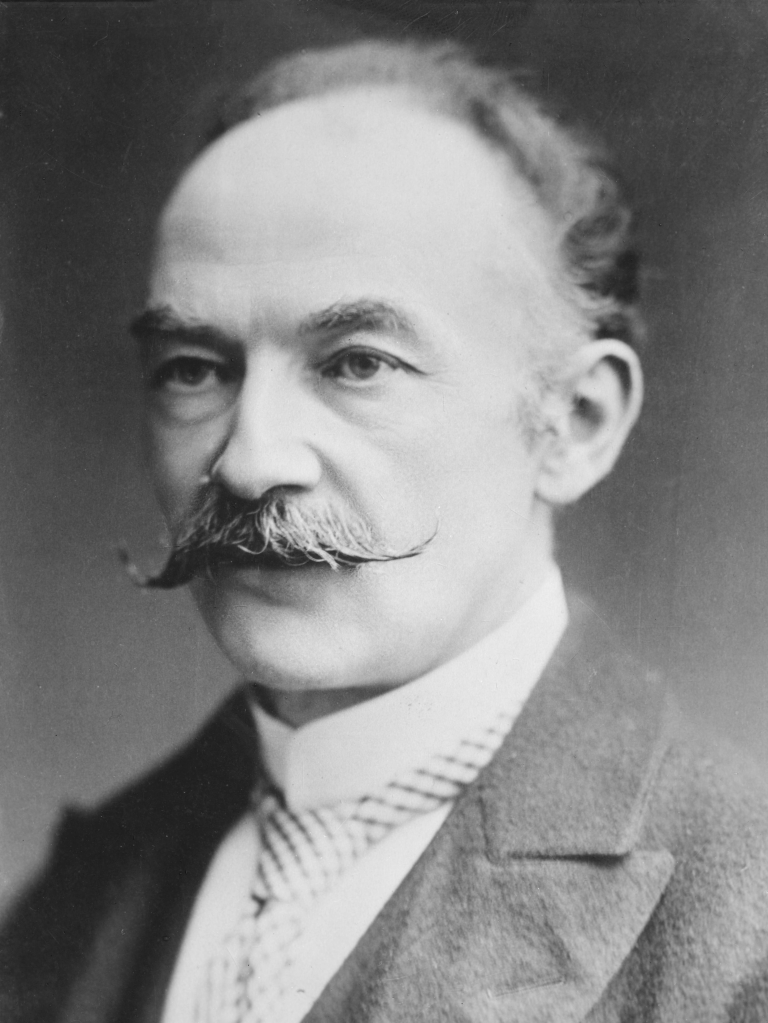
Thomas Hardy (1840 – 1928) was an English novelist and poet, whose name in the UK is synonymous with the landscapes of rural Dorset, where he lived. Born in Higher Bockhampton near Dorchester (literary pilgrims can visit his childhood home, which now belongs to the National Trust), Hardy drew heavily on the people, places and traditions of the local area, transforming the Dorset countryside into the fictional county known as Wessex.
But don’t be fooled by the rolling hills, babbling brooks and chocolate-box villages in his novels. Hardy’s works are packed with big questions about fate, love, societal pressures and ambition, and the choices that shape our lives.
His works have endured because they tackle many issues still exist today – the difference being that we now have names for them. Coercive control, sexual assault and abusive relationships all feature, 200 years before Me Too!
Hardy began his career as an architect, before turning increasingly towards literature. Between 1871 and 1897, he published 14 novels and 3 volumes of short stories, including some of his best known works. Following a negative critical reception to his most controversial novel, Jude The Obscure, Hardy concentrated on poetry, publishing around 1000 poems in his lifetime.
Five Fun Facts
- He trained as an architect
Before becoming an author, Hardy worked as an architect. His work influenced the attention to buildings, landscapes and the physical details of Wessex described in his novels.
- Wessex wasn’t quite what it seemed
Hardy’s Wessex was inspired by the real landscapes of Southern England. If you’re a Hardy fan and you’ve visited the villages of Somerset or Devon, it is difficult not to picture the events of his novels taking place there. Indeed, Hardy even created fictional names for real locations, giving his own novels their very own recognizable literary map.
- He built his own house
Hardy’s home in Dorchester, Max Gate, was designed and built by Hardy with his first wife, Emma. He remained there until his death in 1928.
- He was an accomplished poet
We know Hardy from his legendary female characters – Bathsheba Everdene, Sue Bridehead – and his novels, but he was also a prolific poet. His later career produced 8 volumes of poetry and The Dynasts, an enormous poetic drama about the Napoleonic Wars.
- His influence stretches beyond the Victorian era.
Hardy’s writing helped to bridge the Victorian and modern periods. His influence paved the way for modern writers such as W.H. Auden and Philip Larkin.
Key Themes in Hardy’s Work
- Love and relationships
In Hardy’s novels, love rarely follows a neat or predictable path. Romance, desire, heartbreak and passion are often tied together, sometimes with disastrous results.
- Fate and chance
Small decisions and unexpected events can alter the entire course of a character’s life in Hardy’s Wessex. The question of how much control we have over our own lives looms large. An ill-advised marriage, the choice to marry/not marry, or to harm another – all feature in Hardy’s novels.
- The rules of society
Hardy’s characters often struggle against the constraints of their class, or the expectations of their communities. Class, gender, reputation and social conventions all have enormous consequences.
- Change and modernity
The Industrial Revolution meant that Hardy lived through a time of great change and significant in England. His works frequent explore the tensions between old traditions and the modern world.
- Loss and memory
In Hardy’s later work, these themes demonstrate themselves powerfully. Personal memories, grief and the inevitable passage of time all take centre stage.
Key Works
- Far from the Madding Crowd (1874)
- The Return of the Native (1878)
- The Mayor of Casterbridge (1886)
- The Woodlanders (1887)
- Tess of the d’Urbervilles (1891)
- Jude the Obscure (1895)
- Wessex Poems (1898)
- The Dynasts (1903–1908)
Start with….
Tess of the D’Urbervilles
If you’re new to Hardy, Tess is a great place to begin. (bring tissues though)
Published in 1891, it contains many of the ingredients that make Hardy’s works so compelling: the Wessex countryside, complicated relationships, a headstrong female lead, life-changing decisions, and an ending you will never forget.
At its heart is Tess Durbeyfield, whose family connection to the aristocratic D’Urberville family and her love for Angel Clare, prove to be her undoing.
It’s atmospheric, dramatic and very readable – a good place to start if you’re new to the classics.
Avoid…..
Jude The Obscure.
Well, not avoid exactly. Just maybe don’t start with this one.
Jude The Obscure is a fascinating and important novel, but it is BLEAK. Its exploration of love, class, societal pressures and education makes for powerful reading, but it isn’t the coziest read and may test the less experienced Hardy fan.
I loved it and still do, but I accept that it isn’t the best introduction if you’re new to Hardy. When you have a taste for Hardy’s style though, it is absolutely worth returning to.
Why read Hardy today?
Because Hardy understood something that still feels relevant : people don’t always get the lives they imagined for themselves.
His characters make a lot of mistakes. They fall in love, they marry. They change their minds, they decide they love someone else instead. They try to make sense of circumstances beyond their control.
Sound familiar? I think it does.
Hardy writes tragedy very well, but it isn’t all doom and gloom in his works. There is wit, tenderness and humor. Not to mention vivid storytelling, and the beautiful landscapes of Wessex.
If you’re looking for novels where even the muddiest country lane can feel like a grand, captivating literary landscape, look no further: Thomas Hardy is your man.





Leave a Reply