Yesterday we explored the life and works of Thomas Hardy.
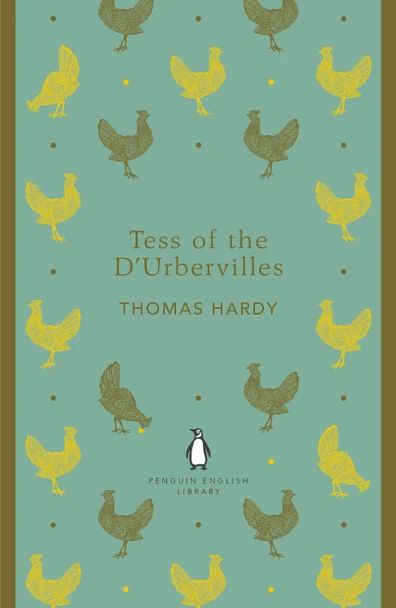
Today, let’s take a closer look at my favorite of his novels, Tess of the D’Urbervilles.
The plot: On the surface, Tess is a story about a young woman whose life is transformed by the discovery that she may be descended from a prominent local family, the aristocratic D’Urbervilles. But this inheritance quickly becomes a source of tragedy, not privilege.
Tess Durbeyfield is sent to seek help from the wealthy D’Urbervilles, after her family learns that they may be related. There she encounters Alec D’Urberville, whose treatment of Tess sets the course for the events that follow.
The novel follows Tess’s attempts to build a life of her own, and eventually a relationship, with the idealistic Angel Clare. Their love is complicated by the expectations, prejudices and double standards of Victorian society.
Throughout the novel, Tess is repeatedly judged by standards that are far less demanding of the men who surround her. It is a story about a woman who lives her life against a social system obsessed with reputation, purity, respectability and class.
The consequences, when they come for Tess, are devastating.
What did I think of this book?
Tess of the D’Urbervilles is deservedly one of the greatest novels ever written, and arguably one of the books of my life.
That’s a bold claim, but it exists because Tess is a character who seems to exist beyond the page. We see ourselves in her, we see people we know. She is very real to us, a whole person. She is complex too ; neither a passive victim nor a perfect heroine. Like many women after her, and indeed many women today, she is simply a young woman trying to make choices within circumstances that repeatedly restrict the choices available to her.
Viewing the novel through a modern lens makes some aspects of it particularly striking. Contemporary readers will recognize the injustice of holding Tess responsible for circumstance in which she has so little power. We recognize the language applied to Tess, even if much of it is no longer in use today: “purity”, “fallen woman”. The social context is distinctly Victorian, but Hardy’s exposure of a culture in which a woman’s sexual history determines her value still feels very relevant.
But then again, as modern readers we shouldn’t assume that Hardy always sees the world exactly as we might. At times his treatment of Tess is idealized, and his descriptions of her beauty and innocence occasionally reinforce the ideas about femininity that the novel otherwise challenges. In its own way, it is a form of pandering to the male gaze.
Hardy’s writing can be demanding. His descriptions of landscapes and rural life are lengthy, and the pace can feel slow at times. But these passages are important. The landscape becomes part of the novel’s emotional world, connecting its tragic events with a larger world of nature, industrialization and social change.
It is a novel that feels at once intimate and enormous.
What was most interesting about this book?
Hardy’s exploration of morality and social judgement is what was most interesting for me.
Victorian society placed enormous importance on female respectability. Tess’s reputation becomes almost as important as her actual character, and Hardy repeatedly demonstrates the cruelty that can result when society values appearances over compassion.
This is still incredibly relevant to modern readers. Who hasn’t felt judged when their life looks different to what “should” be respectable? The language may have changed since Hardy’s time, but questions about shame, reputation and the treatment of women remain very much a part of contemporary conversations.
What will readers take away from this book?
I think the primary lesson readers will take away from Tess’s story, is that people should not be reduced to their past.
Tess is repeatedly defined by experiences that society believes should determine her worth. Hardy asks us to consider whether a person’s mistakes, suffering or circumstances should permanently dictate how the world sees them. After all, what woman (or man) has not entered into an ill-advised relationship that they now regret? Who has not made choices that they now regret?
We’re also encouraged, as readers, to consider how much control we have over our own lives. Tess’s choices in the novel exist within a complicated network: family obligations, poverty, societal expectations and chance. It doesn’t mean that Hardy is suggesting we have no agency over our lives. But he is asking us to consider the circumstances in which that agency operates.
I think that is why Tess and her story continue to resonate.
There is no doubt that Victorian England was a very different world from the one we inhabit today, but the questions raised by this novel are familiar: Who will be judged? Who will be forgiven? Whose mistakes will be considered permanent? And how much does society truly allow people to reinvent themselves?
The central concerns of the novel have not disappeared. We can, and do, approach it through the lens of modern terminology: gender equality, sexual assault, violence against women, victim blaming, slut shaming, stigma, and coercive control.
Literature doesn’t need to reproduce our own world to be relevant to us. Sometimes, literary value comes from allowing us to see how another society understood questions that still matter today. That’s what Tess of the D’Urbervilles does so well.
Is Tess of the D’Urbervilles a good introduction to classic novels?
Absolutely!
If you give it the time and attention it deserves, it will reward you appropriately.
If you’re new to the classics, Hardy’s prose and the slow pace may feel challenging initially. It isn’t a book that races towards its conclusion. The style of the novel is very different from much of modern literature.
What it has is a compelling story, memorable characters (even if Angel Clare is ultimately a bit of a wet lettuce), beautiful descriptive writing, and big themes that remain accessible to modern readers.
More importantly, it demonstrates that reading classic literature doesn’t have to mean reading something archaic, or agreeing with every word the author writes. We can understand the novel’s historical context without allowing it to prevent us from asking difficult questions.
Hardy’s world may be Victorian England, but the questions he asks still belong to our modern landscape. And that is what makes Tess of the D’Urbervilles one of the great literary classics.





Leave a Reply